
- Mar 1, 2025
The Human Connection: A Therapist's View on AI and Loneliness in Modern Practice
- Robyn Walser
- Acceptance & Commitment Therapy, Mental Health & Mindfulness
- 0 comments
We Have a Big Job in a Tech World
As a person in great favor of the interpersonal relationship in psychotherapy (and just in general), I have been worried about the development of AI therapists. I recognize that this could have tremendous reach, but also fear loss of connection to real, in the flesh, humans. It is particularly disquieting as the World Health Organization (WHO) has raised growing concerns about isolation and loneliness, recognizing loneliness as a significant public health matter. Research has shown that chronic loneliness can have severe effects on mental and physical health, increasing the risk of mental health problems, cardiovascular disease, and even premature death. The WHO emphasizes that social connections are as crucial to well-being as diet, exercise, and sleep. Some areas of the world are starting to provide “social prescriptions” to combat this emerging issue – actually writing prescriptions to get people to connect (e.g., referring people to community groups, volunteer opportunities, exercise classes, arts programs, or even nature-based therapies).
Many of you probably already get your clients connected whenever you can. And through ACT help clients change how they relate to loneliness. Instead of seeing it as a personal failure, they can recognize it as a shared human experience. We can also encourage meaningful action and get clients to participate socially. Ugh, this might mean getting them to unplug! Here are the benefits:
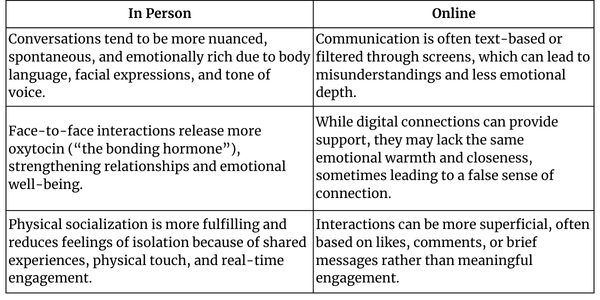
I am sending out a call to get our clients (and ourselves) connected!
Research Spotlight: Continuing With the Theme
From an ACT perspective, there is some good news regarding working with social isolation and loneliness. Namazi et al. (2022) found that ACT is effective in increasing psychological hardiness and reducing social isolation and loneliness of women with breast cancer. And Mahmoudpour et al. (2021) found a significant reduction in the loneliness of divorced women who received the ACT intervention.
It’s a good start! If you are interested, links to the articles are below.
Namazi, R., Sahragard, S. B., Pourkaveh, H., Homayoon, S., Mirniyma, S. K., & Seyed Jafari, J. (2022). Effectiveness of Acceptance and Commitment Therapy on Psychological Hardiness, Social Isolation, and Loneliness of Women with Breast Cancer. Journal of Clinical and Basic Research, 6(1), 1–10. https://jcbr.goums.ac.ir/browse.php?a_id=343&slc_lang=en&sid=1&ftxt=1&html=1
Mahmoudpour, A., Rayesh, N., Ghanbarian, E., & Rezaee, M. (2021). Effectiveness of Acceptance and Commitment Therapy (ACT) on Emotional Regulation and Loneliness of Divorced Women in Iran. Journal of Marital and Family Therapy, 47(3), 1–12. https://doi.org/10.1111/jmft.12492
Personal Reflection:
If we bring isolation and loneliness home, we might find ways where our own struggle with these issues surfaces. I invite you to consider a few questions: What qualities do I value in my interactions with others? Am I socializing in person enough to combat mental and other health problems? How much time do I spend socializing online compared to in person?
If answering these questions left you in a place where you might like to change something, well, then…if you know me, you know I would say, “Do it!”
ACT Micro Practices:
Pause & Breathe – Take a slow, deep breath. Notice any thoughts or feelings of loneliness or attempts to isolate or hide, to disconnect socially.
Acknowledge Your Experience – Say to yourself, “I’m noticing I am having the feeling of loneliness.” Offer compassion by placing a hand on your heart and letting it rest there as a representative of kindness.
Orient to Values – Ask yourself, “What does this loneliness tell me about what I care about?” (e.g., connection, love, belonging).
Take One Small but Bold Action – Send a message to a friend, smile at a stranger, say hello on the street, get a cup of coffee with a friend.
Be Present in Your Connections – Practice being fully present, listening, and engaging with heart with those you interact with.
Events and Resources:
Go here to get a compassion mindfulness exercise.
Upcoming Trainings:
ACT BootCamp in Denver, Colorado, May 1-4., 2020
ACT Boldly: Advanced Process-Based Workshop, San Francisco, May 9-10, 2025
ACT BootCamp in Utrecht (near Amsterdam), Netherlands, September 25-28, 2025
ACT Retreat on Zanzibar, Tanzania, January 17 - 24 January, 2025.
